Traditional Mexican costume. Typical pieces of clothing in Mexico
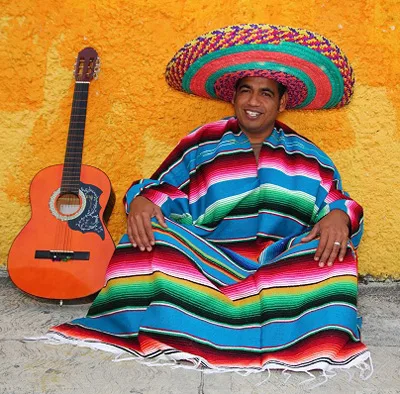
Mexican national clothing is very bright and beautiful. Actually, there are many different designs of traditional costume. Some of them are used for celebrations and holidays, some – for ceremonies, some – for festivals. The main characteristics of Mexican national attire are: sun protection (that's why sombrero has such a wide brims and the clothing itself is made of natural materials), brightness (the fabric for garments is mostly colorful and heavily embroidered; a lot of colorful ribbons are used), and moderate modesty (the clothing is elegant, not shameless or vulgar at all; skirts are long, blouses are delicate; flowers are often used to beautify the costume, hairdo and headdress).
Traditional Mexican men's costume has changed very little during centuries. But we can't say the same about women's clothing. Most of costumes were formed by mixing the culture of Native Americans and European people (mostly Spanish new settlers).
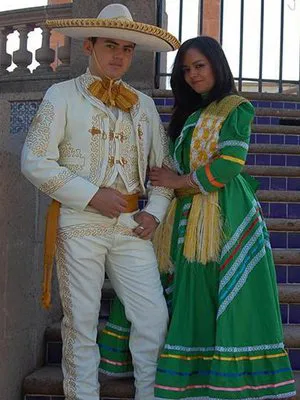
Mexican traditional attire. Photo from Mexican-clothing-co.com
The national clothing of Mexico is made of various fabrics: wool, cotton, silk, agave, and bark. Usually the colors of traditional dress are red, brown, green and yellow. Mexicans used to dye their clothes with natural components, but today they don't have to do that.
Traditional men's pieces of clothing
The most popular and well-known men's pieces of clothing in Mexico are sarape, charro suit, sombrero, guayabero, baja jacket, and poncho.
Sarape is a vibrantly colored garment with a fringe. It is used as a shawl-like coat and also as a blanket.
Read also:
Mexican wedding traditions. Sponsors, pinata, and gold coins as a gift
Charro suit is a special beautifully embroidered suit which is worn on the Day of the Dead.
Sombrero is a Mexican hat with a wide brim. This hat is made of straw or heavy felt. It protects the body from the sun. This part of clothing is the most recognizable around the world.
Guayabero is a lightweight shirt or suit which is used both as a casual and formal dress. It is made of cotton and very often is decorated with heavy embroidery. Guayabero is perfect attire for Mexican heat.
Man in national Mexican clothing. Photo from Globerove.com
Baja jacket is a Mexican hooded shirt which is very popular among Mexican and American youth. Mostly men wear it, but women sometimes also do. It is loved by hippies. Baja jacket usually is rather warm, it has a hood and a large pocket situated on the belly. Baja jacket is often colorful, with striped pattern and looks very youthful.
Poncho is one of the typical Mexican pieces of clothing that is well-known and loved all around the world. It is a warm outerwear. There are many different variations of poncho. For example, classical poncho is a simple piece of cloth with a hole for the head; it doesn't have sleeves, but sometimes has a hood. Rainproof poncho is fitted with fasteners for the sides or has openings for the arms. It is more typical for men to wear poncho, but some women use it too.
We could dedicate the whole chapter to Mexican shoes, but we'll make it short and tell you only the main information. There are several types of traditional Mexican men's shoes: huaraches, Mexican pointy boots and Mexican cowboy boots.
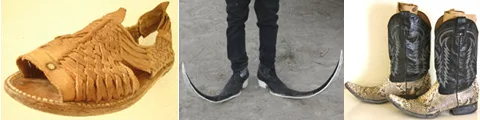
Huaraches, Mexican pointy boots and Mexican cowboy boots
Mexican cowboy boots look pretty much like American ones. They were used by cowboys in Mexico from 1800s. They are made of leather (often exotic animal skin is used – armadillo, bull, ostrich, lizard), they can be high-heeled or flat-heeled, with high or low boot-top. Mexican cowboy boots usually have narrow pointed toes. Huaraches are the most common shoes in Mexico. They are sandals, rather simple to make. There is a great variety of huaraches. Usually they are made of leather (modern huaraches can be made of synthetic materials). Huaraches are always handmade. Mexican pointy boots are very unusual and astonishing. They have narrow and elongated toe. Sometimes their toe is up to 1.5 meter (5 feet) long and curved up to the knees of a man. Usually Mexican pointy boots are very colorful, often decorated with such elements as flashing LED lights, disco balls and even mirrors. They are often worn by bands, singers and dancers.
Traditional women's pieces of clothing
The most popular and well-known women's pieces of clothing in Mexico are huipil, quechquémitl, rebozo, Mexican skirts (they have various names in different regions – enredo, chincuete, posahuanco, refajo, enagua).
Huipil is a sleeveless tunic, made from cotton or wool. It is worn with a skirt. The design of this piece depends on a region, beliefs, marital status and so on. Huipil is one of the most popular women's clothing in Mexico.
Share your own or your ancestors’ love story with the world!
Our partner website Weddingsallovertheworld.com starts a new project where people can publish their own Wedding Story or – and that’s even more exciting! – the Wedding Story of their ancestors. If you know how your grandparents, great grandparents, or other relatives met and got married, don’t miss the chance to tell their story. Isn’t it romantic and adorable to read real-life love tales that happened dozens or even hundreds of years ago?!
You’ll find details here: Your Wedding Story
Quechquémitl is a festive kind of poncho. It is worn for parties, holidays and festivals. Quechquémitl should be handmade from handwoven cloth. Also it is often heavily embroidered. It is very colorful and beautiful.
Rebozo is a shawl/scarf made from cotton, wool, or silk. The color and pattern of rebozo represent the region and community. This piece of Mexican traditional costume is used not only as clothes, but also to carry products and goods, even babies.
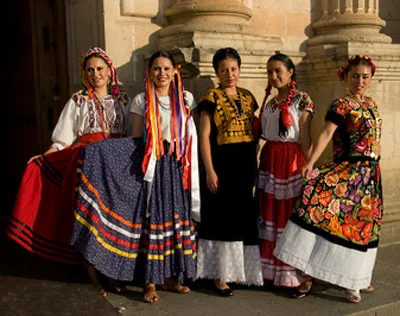
Women in traditional colorful Oaxaca dresses. Photo from Nativepeoplephotographer.typepad.com
Mexican skirts can be ankle-long or knee-long. They are made from cotton, wool, silk and lace. Very often they are wide, bright and embroidered.
Mexican women also like blouses very much. There is a great variety of blouses. But usually they are beautifully decorated with lace, beads, colorful patterns, and embroidery.
Traditional Mexican dress designs
Every corner of Mexico has its own traditional dress design. Mexican women wear very beautiful and feminine dresses. For example.
Jalisco Traditional Dress
It is also called Escaramuza dress. It consists of a cotton blouse with a high collar, and stripes of embroidery; and a wide skirt. The skirt is very nice-looking, its waves are decorated with stripes and form a star of stripes on hips.
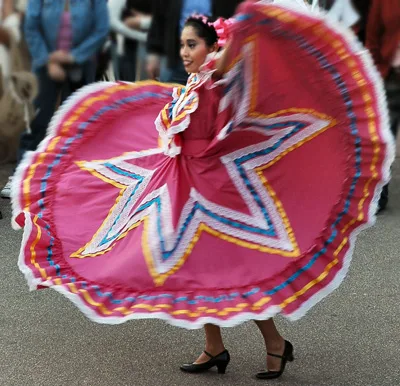
Jalisco Traditional Dress
Michoacan Traditional Dress
Dresses of this style are very sophisticated. They consist of a long skirt with ribbons or patterns; a long blouse embroidered at the bottom and around the neck; a belt; and rebozo. Embroidered aprons are also used.
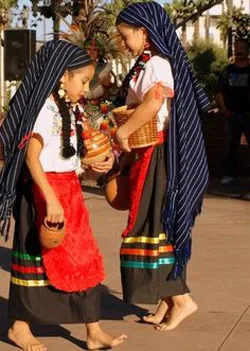
Michoacan Traditional Dress. Photo from Pinterest.com
Tabasco Traditional Dress
This dress is very feminine and delicate. Women in this region like floral embroidery, bright ribbons and hair decorations with flowers. Tabasco dress consists of a white blouse with embroidery around the neck and on sleeves; black or colorful skirt with floral pattern. Accessories are welcomed.
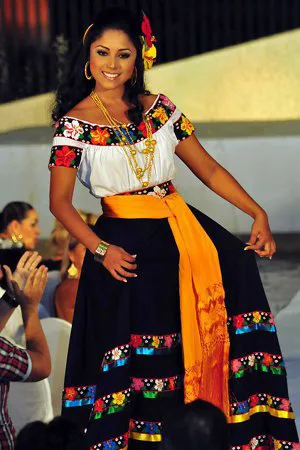
Tabasco Traditional Dress. Photo from Mexican-clothing-co.com
Campeche Traditional Dress
This dress design was formed under the Spanish influence. It consists of a long wide skirt made of Spanish print fabric, often decorated with lace; a white blouse with a square collar and black embroidery; and rebozo.
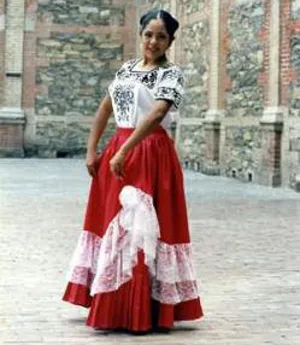
Campeche Traditional Dress. Photo from Mexican-clothing-co.com
Chiapas Traditional Dress
These dresses are really unique and extraordinary. They are handmade; women from the town Chiapa de Corzo make these dresses. They consist of a wide skirt and a blouse (or dress), very heavily embroidered and decorated with ribbons. The background is black, and the embroidery is colorful and bright. Usually flower patterns are used.
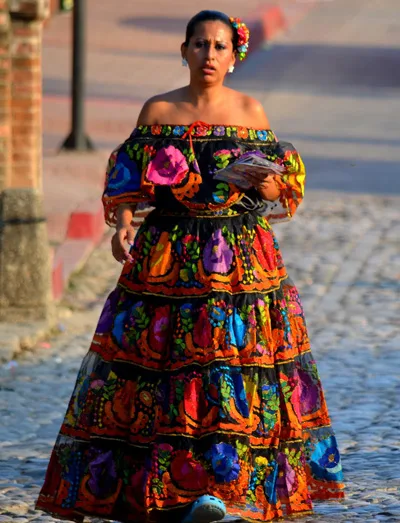
Chiapas Traditional Dress. Photo from Skyscrapercity.com
Traditional Mexican accessories
There are a lot of accessories which go with the national Mexican costume. Accessories for women are: ribbons, ritual necklaces, amulets, tehuana headdress, and tzutes (woven piece of cloth – shawl or scarf). Women in this country like ribbons very much. They often wear ribbons around the neck, as a necklace. Also they use unusual materials as accessories. For example, seashells and fishbones are used.
Accessories for men are: cowboy hats and boots, sombreros and other wide hats made of straw and palm leaves, moral, and faja. Moral is a typical bag with shoulder strap, it is very popular in Mexico. Faja is a kind of sash which is worn with pants and capixay (pullover), and function as a belt.
Mexican people are very religious and superstitious. So they often wear different amulets and guardians which are believed to defend people from evil. Amulets are popular among both men and women.
51 archived reader comments
Preserved from the original site. New comments are closed.
This is fantastic! Thank you for this wonderful article! :-)
mexican not mexicant 8)
Thank you for making this article! It was very helpful!!!
this is not accurate :-|
[quote name="Susie Cochrane"]This is fantastic! Thank you for this wonderful article! :-)[/quote]no,its not fantastic. its not that accurate. :-)
:D it help me, thanks!
Very helpful article :roll:
fantastic thanks
This article aint good. I almost had a heart atttack
This is so help full :-) Thanks
its half and half not accurate and accurate :-? :-| :sigh:
this was not helpful...
Most of these are not even true, please research better or have someone Mexican write about Mexican culture.
no i love
You must ask some Mexican about traditional clothing. These are not too correct.
not every costum is Mexican,but its okay.Thanks!.
from mrs. rodriguez's spanish class at menchville high school. esketit
it really really helps me :D and plus to other face is :3 :p
Thanks for making this, it helped a lot.
I'm proud to be a Mexican.
Mexican dress had mostly Spanish and south European design. Spanish tailors had a significant impact.
What is the traditional dress of Mexico for kids?
[quote name="Napoli"]What is the traditional dress of Mexico for kids?[/quote]Mexican kids often wear tiny variants of adult folk clothing: tiny ponchos, charro suits, sombreros, huipiles, wide Mexican skirts, etc. The cut and design of these pieces is the same as in adult costumes. Just the size is smaller
[quote name="Anna"] charro suits, sombreros, huipiles[/quote]What are traditional mexican dresses called huipiles and charro?
I'm in Love with Mexican attires
mexico costume, mexican clothing, I'm needing more information for my school project
[quote name="Selena"]I'm proud to be a Mexican.[/quote]+1
We are "Mestizos". This is mix between cultural traits incorporating elements from ancient indigenous and Spanish traditions.
Beautiful and artistically driven. The words flow so beautifully and the words choice is amazing. I love the writing and the pictures compliment the true Mexican culture. I may be Italian but i can sure rock a good sombrero.
i love to learn about the Mexican culture. This article is absolutely one of the best i have read. Thanks for writing it. So inspirational and also great writing.
okay, lets get to the point...this article is the best i love how they give so much information about the topic being written and as a struggling author myself this is truly one of the best i have seen. Thanks for showing the true Mexican culture, SHister SHister
anyone doing ms mez work
I need help doing a Cinco de Mayo party at a 73 yr old mex restaurant , I was told of traditional style shirt. It starts with the letter M and kind of sounds like thong. Usually there is floral pattern on each side of the shirt.
im in school and this is helping
The men s costume got somewhat modernized. Many Indians are wearing a large manta which is woven by hand. Most of the time rolled on the shoulder , a white shirt and white pants with a big belt. Often, an embroidery design adorns the neck opening or the shirtfront. At the Tarahumara from the North, men are wearing shirts and a loincloth hold with a fabric belt, which covers the legs. Indians from the southern States are wearing colorful and primitive clothes, which are among the most beautiful of Mexico. In the tribes Tzotzil in Chiapas, men are wearing a very large cloth falling to the knees and brought together to make sorts of pants, a shirt with embroidered collar and cuffs, a very colorful scarf and a palm hat with a crown adorned with a braid made with multicolor ribbons. Right picture : indian girls with traditional clothes The Dandies The Huicholes believe that a sumptuous suit would raise human to the rank of Gods. They bring an attentive care to their clothes : Shirts and pants are embroidered, belts and bags are weaved. It is the only tribe where the men s suit is richer than the women s suit. The Indian women adopted clothes that will fit her as a little girl as well as a young woman, a mother, a grandmother. And. One detail or another one will be different from one place to another one. What are the preferred clothes of these elegant women ? Huipil or quechquemitl, skirt, large belt, headgear and jewelry, flowers and ribbons in the hair. You could meet an Indian with sandals but usually they go bare foot like in the old time. The huipil, rectangular dress with head and arms openings, is very popular in southern Mexico, from the state of Oaxaca to the boarder of Guatemala. It is made of wool or cotton, long or short, tight or more often large and covering the shoulders, made of one piece or several pieces assembled together with ornamental ribbons or braids.
This is very true I was born in Mexico and traveled all around Mexico and this is definitely true woman love bright colors there it’s our thing I’m actually 10 and still live here but will be moving to the USA does any one have advise for me my new teacher in America emailed me that she wanted me to do a presentation so I’m getting quotes from websites but if any Americans have advice for me to fit in there plz share
Folk dance of Mexico, commonly known as baile folklorico, is a term used to collectively describe traditional Mexican dances. Ballet folklorico is not just one type of dance, it encompasses each region's traditional dance that has been influenced by their local folklore and has been entwined with ballet characteristics to be made into a theatrical production.
Traditional Mexican women s clothing regularly includes lots of ornate embroidery, often including images and patterns that have symbolic meaning attached to them. Typically men s clothing is not as colorful as women s. In fact, typical pre-Columbian clothing is hard to find today. This is because men often went with little or no clothing, using mainly a sarape in certain areas of Mexico.
this was vewy hewpful uwu
No saben sobre Mexico
Nice embroidery! Really nice clothing.
[quote name="Edenfantasys"]The men s costume got somewhat modernized. Many Indians are wearing a large manta which is woven by hand. Most of the time rolled on the shoulder , a white shirt and white pants with a big belt. Often, an embroidery design adorns the neck opening or the shirtfront. At the Tarahumara from the North, men are wearing shirts and a loincloth hold with a fabric belt, which covers the legs. Indians from the southern States are wearing colorful and primitive clothes, which are among the most beautiful of Mexico. In the tribes Tzotzil in Chiapas, men are wearing a very large cloth falling to the knees and brought together to make sorts of pants, a shirt with embroidered collar and cuffs, a very colorful scarf and a palm hat with a crown adorned with a braid made with multicolor ribbons. Right picture : indian girls with traditional clothes The Dandies The Huicholes believe that a sumptuous suit would raise human to the rank of Gods. They bring an attentive care to their clothes : Shirts and pants are embroidered, belts and bags are weaved. It is the only tribe where the men s suit is richer than the women s suit. The Indian women adopted clothes that will fit her as a little girl as well as a young woman, a mother, a grandmother. And. One detail or another one will be different from one place to another one. What are the preferred clothes of these elegant women ? Huipil or quechquemitl, skirt, large belt, headgear and jewelry, flowers and ribbons in the hair. You could meet an Indian with sandals but usually they go bare foot like in the old time. The huipil, rectangular dress with head and arms openings, is very popular in southern Mexico, from the state of Oaxaca to the boarder of Guatemala. It is made of wool or cotton, long or short, tight or more often large and covering the shoulders, made of one piece or several pieces assembled together with ornamental ribbons or braids.[/quote]oof!
[quote name="Lojina noneofurbeezwax"]heh anyone from Mrs.Hendricksons class?( ANYONE IN MRS HENDRICKSONS CLASS WRITE YOUR LAST NAME AS NONEOFURBEEZWAX!!)[/quote] HELLO!! HI LOJI!!!!!!!!!
heh anyone from Mrs.Hendricksons class?( ANYONE IN MRS HENDRICKSONS CLASS WRITE YOUR LAST NAME AS NONEOFURBEEZWAX!!)
[quote name="Sofia noneofurbeezwax"][quote name="Lojina noneofurbeezwax"]heh anyone from Mrs.Hendricksons class?( ANYONE IN MRS HENDRICKSONS CLASS WRITE YOUR LAST NAME AS NONEOFURBEEZWAX!!)[/quote] HELLO!! HI LOJI!!!!!!!!![/quote]
Beautiful and artistically driven. The words flow so beautifully and the word choice is amazing. I love the writing and the pictures complement the true Mexican culture. I am also Mexican but I have shifted my lifestyle to American and started wearing Port & Company - pc54 t-shirts.
[quote name="Sam"]Are Huaraches fairly universal in Mexico or is there a specific group of people who are more likely to wear them?I am a teacher in South Korea and I am taking my students on a virtual tour of the world and I don't want to generalize or misrepresent Mexican culture. If huaraches are worn by most everyone I would like to use them because it gives a connectedness to the country/ world. while also showing the diversity even within one country.[/quote]It’s believed huaraches originate from Yucatan, Jalisco, and Michoacan regions of Mexico. But they became popular practically all around Mexico. Though, I’m not so sure if they’re considered folk shoes of a certain ethnic group or just general shoes for Mexico
Are Huaraches fairly universal in Mexico or is there a specific group of people who are more likely to wear them?I am a teacher in South Korea and I am taking my students on a virtual tour of the world and I don't want to generalize or misrepresent Mexican culture. If huaraches are worn by most everyone I would like to use them because it gives a connectedness to the country/ world. while also showing the diversity even within one country.
[quote name="Sofia"][quote name="Sam"]Are Huaraches fairly universal in Mexico or is there a specific group of people who are more likely to wear them?I am a teacher in South Korea and I am taking my students on a virtual tour of the world and I don't want to generalize or misrepresent Mexican culture. If huaraches are worn by most everyone I would like to use them because it gives a connectedness to the country/ world. while also showing the diversity even within one country.[/quote]It’s believed huaraches originate from Yucatan, Jalisco, and Michoacan regions of Mexico. But they became popular practically all around Mexico. Though, I’m not so sure if they’re considered folk shoes of a certain ethnic group or just general shoes for Mexico[/quote]On a visit, I noticed they don't wear huaraches a lot. I think they are considered folk shoes. [/quote]
[quote name="Marquez"]Could you stop referring to our traditional clothing as a costume, please it's very disrespectful.[/quote]We mean no disrespect. When we say "costume", we mean a set of clothing, as opposed to a number of separate garments without any connection. We only imply that the attire is a single unit. Sorry if this offended you somehow
Could you stop referring to our traditional clothing as a costume, please it's very disrespectful.